Barahnaja organics
Foxtail millet (Koni)
Pindar valley
5600ft
✅ Traditional Himalayan Millets
✅ Light & easy to digest grain
✅ Gluten free and nutrient dense
Naturally gluten free
No additives or preservatives
Heirloom Himalayan variety
Low G.I
Couldn't load pickup availability
Harvested in limited seasonal batches
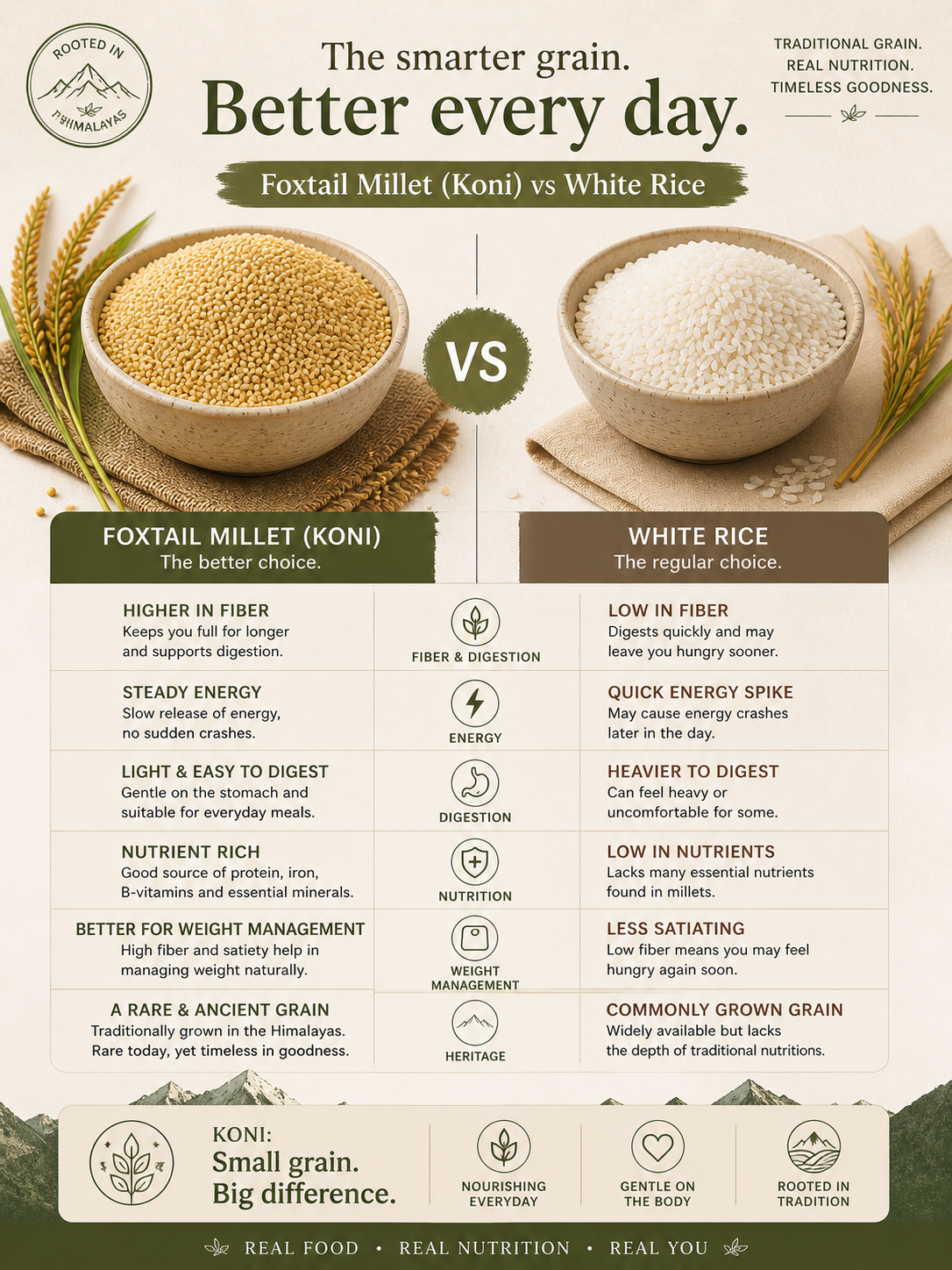
Harvested from traditional Himalayan regions, Foxtail Millet (Koni) is a balanced, everyday grain known for its steady energy release and light yet satisfying nature. Unlike refined grains that digest quickly and lead to sudden hunger, Koni is traditionally valued for keeping you fuller for longer while remaining gentle on the body. It fits naturally into regular meals without feeling heavy.
⸻
What to Expect
- Texture: Light, slightly grainy and separate when cooked
- Taste: Mild, slightly nutty and easy to pair with everyday meals
-
Cooking: Can be cooked like rice or used in khichdi, pulao and simple meals.
🌾 Grain Profile
🌾 Grain Profile
Grain Type
– Foxtail millet (Koni)
Cultivation
– Traditionally grown in Himalayan regions
Processing
– Minimally processed, unpolished
Texture
– Light, slightly grainy and separate when cooked
Flavor
– Mild, slightly nutty
✨ Why this grain
✨ Why this grain
1. It is traditionally cultivated in Himalayan regions and valued for its resilience to dry conditions. This natural adaptability results in a grain that is hardy, wholesome and suited for everyday nourishment.
2. It provides steady and sustained energy as it digests more gradually compared to refined grains, helping you stay fuller for longer without sudden hunger spikes.
3. Naturally rich in dietary fiber and essential minerals, it supports better digestion and contributes to overall nutritional balance in daily meals.
4. Being naturally gluten-free, it is suitable for those avoiding gluten and looking for a lighter, grain-based alternative to wheat and refined cereals.
🍽️ How to use
🍽️ How to use
Foxtail millet (Koni) can be used just like rice in everyday cooking. Rinse and cook it with water to make simple meals like khichdi, pulao or plain grain for curries. It cooks relatively quickly and pairs well with both vegetables and dals. You can also use it in porridge-style preparations for a light, wholesome meal.
📦 Shipping & Storage
Packed in food-grade, moisture-resistant packaging to retain its natural freshness and texture.
Store in a cool, dry place. Transfer to an airtight container after opening to maintain quality over time.
Orders are dispatched within 24–48 hours. Delivery timelines vary by location.
Nutrition Information
Share

YOU ASKED, WE ANSWERED
FAQs
Are your millets polished or unpolished?
Our millets are minimally processed and largely unpolished, retaining their natural fiber, nutrients, and traditional taste. We avoid excessive polishing so you get closer-to-natural grain, just as it has been consumed for generations.
What makes Himalayan millets different?
Our millets are grown in high-altitude Himalayan regions using traditional farming practices without chemical inputs. This results in grains that are more nutrient-dense, naturally resilient, and richer in flavor compared to mass-produced varieties.
Are millets difficult to cook?
Not at all. Millets are easy to cook once you get familiar with basic soaking and cooking ratios. They can be used just like rice for daily meals, or in traditional dishes like khichdi, porridge, and rotis.
Do millets need soaking before cooking?
Soaking is recommended for better digestion and improved texture, but not always mandatory. A short soak of 30–60 minutes is usually enough for most millets.
Are millets good for daily consumption?
Yes, millets can be a great addition to daily meals when consumed as part of a balanced diet. They are naturally rich in fiber and nutrients and are often preferred as an alternative to refined grains.
Which millet should I start with?
If you are new to millets, start with milder varieties like barnyard or foxtail millet as a rice substitute. For traditional recipes, finger millet (ragi) and kodo millet are popular choices.
What is Barahnaja?
Barahnaja is a traditional Himalayan mixed cropping system where multiple grains and pulses are grown together in harmony. It supports soil health, biodiversity, and nutritional diversity — a practice rooted in sustainability and local wisdom.